Effective time management is a vitally important skill in today’s fast-paced world that has been taken to a level beyond just being organized. Managing time is not just a matter of making schedules or setting alarms. It is the cornerstone of life management. Each moment spent doing something meaningful contributes much more to our overall productivity and wellbeing than we realize.
Do you feel helpless and stranded in an island of tasks and unchecked checkboxes? Do you always feel the weight of too much to do but too little time? If so, Effective time management is just the thing for you. It is common for people to be disinterested in time management since it seems like a lot of effort. However, it is not as difficult and boring as it is often believed to be. In this article we will explore how you can use this amazing instrument to change the game of your life!
Table of Contents
What is Effective Time Management?
Effective time management refers to the ability to set goals and prioritize tasks to ensure productivity and success. It is a tool, an instrument, a skill and a pathway to a content lifestyle. It involves planning ahead, creating a schedule in order to avoid procrastination and make the most of each moment. Spending each moment with a goal in mind might sound scary and stressful at first but in reality, it’s pretty simple once you get the hang of it.
A common misconception about effective time management is that resting or catching a break or indulging in hobbies is a waste of time and cannot be included in an effective routine. This is a total myth. The time you spend enjoying yourself is vital for your overall productivity as well.
Advantage of Effective Time Management
Benefits for Personal Life:
Increased Productivity and Reduced Stress:
By prioritizing tasks based on deadlines, significance and urgency and assigning specific times of the day to each task, less time is spent on indecision and worry. This streamlined approach leads to higher output and better results. When tasks are organized and deadlines are clear, individuals experience less anxiety about their workload. By focusing on specific tasks on a certain time of the day, one can get them done properly thus reducing the feeling of being swamped or underwater promoting mental health. This way, you can avoid the last-minute rush and the stress that comes with it.
Improved Focus and better results:
Effective time management builds a well-structured work environment removing worries about other unfinished tasks and thus minimizing distractions. Breaking projects into simpler and manageable steps is an extremely effective method to avoid procrastination. Effective time Management can set you free from the habit of multitasking which often leads to mistakes, stress and decreased efficiency. Thus, time management can also enhance the quality of work you produce.
Better Decision Making:
With effective time management, you get the opportunity to reflect on your choices instead of rushing through them. Allocating time for analysis gives you the chance to weigh your options, leading to more thoughtful decisions. This clarity can improve both personal and professional outcomes.
Enhanced Work-Life Balance:
Effectively managing time, you can create boundaries between work and personal life. Setting aside time for family, hobbies, and self-care is essential for mental and emotional health. This balance prevents burnout and contributes to a more fulfilling life.
Goal Achievement:
Time management is vital for reaching both short-term and long-term goals. By breaking larger objectives into actionable steps and achieving them, you can track your progress and stay motivated. This systematic approach can foster a sense of pride and satisfaction and keep you right on track!
More Time for Self-Care:
In this fast-growing world we are constantly on the run with little to no time to spare for ourselves. By incorporating effective time management in your daily life, you can earn some extra time to dedicate solely to self-care. Be it exercise, meditation, simple relaxation or indulging in hobbies, you can finally send some quality time with yourself.
Increased Confidence:
Successfully completing your works and achieving desired results will boost your confidence which can power you through much more difficult situations.
Benefits for Professional Life:
Mastering effective time management skills is crucial for career advancement. Not only does it create a stress-free workspace but also increases reliability and competency. Furthermore, good time management enhances collaboration and ensures success in teamwork. By completing our task perfectly, we will become a reliable figure in our workplace. It might also result in desired outcomes in professional life such as promotions, better profit and investments and enhanced goodwill.
10 Key Principles Keys of Effective Time Management
10 Key Principles Keys of ETM (Effective Time Management) helps us be efficient with our time. It helps us manage and increase productivity without stressing too much. It also helps us reduce time waste align short term tasks with long term goals. The exact routine and schedule for ETM will be different for each person. So, while we will provide the necessary tools and steps you must prepare the schedule yourself.
Here are 10 principles keys of ETM. These might also be seen as essential steps for effective time management.
01. Prioritization:
- First and foremost, make a list of all the tasks you wish to finish in a specific time period. Now, it is time to rank the tasks based on importance and urgency. A useful tool you can use for this is the Eisenhower Matrix which is discussed in detail further in the article.
02. Goal Setting:
- Once you have established and sorted out your goals, it is time to make them feel achievable. Break the goals down into smaller, actionable steps and create a simple roadmap that easy to keep in mind and follow through.
03. Planning:
- Now it is time to allocate specific times to each goal. The amount of time allocated can vary based on importance and urgency of the task. Using planners or digital calendars is the most effective way to visualize and organize your time and get an overall understanding of your routine at just a glance.
04. Time Blocking:
- Allocating specific blocks of time for different activities helps maintain focus and reduces multitasking.
05. Delegation:
- Handling too much at once and by yourself can be extremely harmful. So, it is important to identify tasks that can be delegated to others. Sharing responsibilities can free up your time for more critical and urgent activities.
06. Setting Deadlines:
- Establish realistic deadlines for tasks to maintain accountability and encourage timely completion. Setting unrealistic deadlines only increases stress and reduces the quality of your results.

07. Avoiding Procrastination:
- There are triggers around us that lead to procrastination and distracts us from the task at hand. Recognize them and develop strategies to overcome them. The Pomodoro Technique is an effective method in this case.
08. Regular Review:
- Reviewing your progress and the effectiveness of your effective time management strategies can make you feel more confident and motivated. It is important to make adjustments if you find your strategy lacking in any aspect.
09. Work-Life Balance:
- Set boundaries to ensure a healthy balance between work and personal life. Allocate time for self-care and relaxation. Remember, time well-spent is also an important part of effective time management.
10. Flexibility:
- Unexpected events can arise any moment. In that case, it is important to not be frustrated and find ways to bend your plans.
By applying these 10 principles keys of effective of effective time management, you can enhance your time management skills and improve your overall productivity and well-being.
Advance Tips and Method of Effective Time Management
1. The Eisenhower Matrix
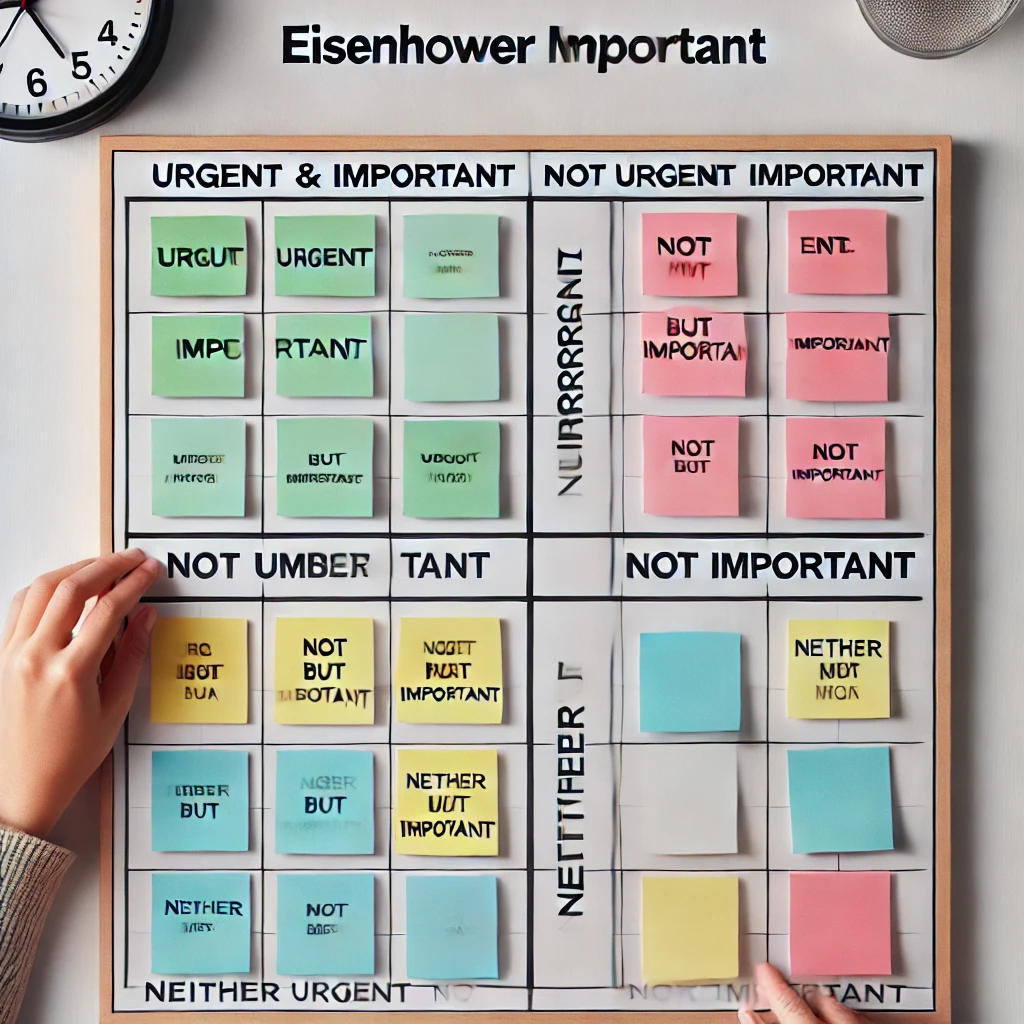
The Eisenhower Matrix is a effective time management tool that helps prioritize tasks based on their urgency and importance. It is divided into four quadrants:
| Urgent and Important: Do it right now! | Important but Not Urgent: Do it later. |
| Urgent but Not Important Find someone who can help. | Not Urgent and Not Important Eliminate or postpone. |
What it is:
We are swamped with many tasks each day and often we stress so much over completing them all that we forget to prioritize them. Prioritization is the most important principal of effective time management that helps us to find out which tasks we should do right this moment and which tasks can wait for a while.
How it works:
Through the Eisenhower Matrix, we can organize our tasks into four categories:
- Urgent and important: that means we have to do the task immediately to achieve our goal.
- Important but not urgent: These are tasks that are important but the deadline is far away or perhaps completing it at a later time will not cause problems. We can schedule these tasks for later but within reasonable time.
- Urgent but not important: These are tasks that might not bear any actual importance to you but you have to finish it within a short time. Since you have many other important tasks to fulfil, dealing with these tasks might hamper your productivity. Delegate these tasks to another person.
- Not urgent nor important: There many tasks in our life that are not urgent and also pretty much useless. If you think a task is unimportant to your overall wellbeing and productivity, then let it go. Eliminate it or postpone it for your free hours after you are done with the important jobs.
By categorizing tasks in this chart, you can focus on what truly matters, improve efficiency and reduce stress.
2. The Pomodoro Technique
The Pomodoro Technique is a effective time management method designed to enhance productivity and focus. It involves breaking goals into intervals, typically 25 minutes long, called “Pomodoro,” followed by a short break of about 5 minutes. Here’s how it works:
- Choose a Task: Select a specific task to work on.
- Set a Timer: Set a timer for 25 minutes.
- Work: Focus solely on the task until the timer goes off. Minimize distractions by putting away anything that might trigger procrastination.
- Take a Short Break: After the 25 minutes, take a 5-minute break to recharge. It is important to stay away from activities that might get you hooked for longer than your break time.
- Repeat: After completing four Pomodoro’s, take a longer break of 15-30 minutes.
This technique helps maintain focus, reduces mental fatigue, and enhances overall productivity by encouraging regular breaks, making it easier to manage time effectively.
3. Setting SMART Goals
- What it means: SMART stands for Specific, Measurable, Achievable, Relevant and Time Bound. This principal helps us set a clear goal that guides us on day-to-day tasks and is also easily achievable. For example; instead of saying “I want to get fit” we could say “I want to run 15 kilometers in the next 30 days”. Here, getting fit is a broad concept and might sound hard to attain. However, running 15 kilometers is much easier to visualize. Having a specific measurable goal which is achievable and relevant motivates us to do the job because it sounds like an easy thing to so. Making the goal time-bound gives us a sense of urgency and ensures consistency.
4. Planning and Scheduling
- What it Means: Having well-structured planning and a specific time frame to achieve our goal keeps us within the track. Like a train, without a structured plan and schedule we will be easily distracted, lose motivation and fail in the task. A schedule is the tangible part of effective time management. Thus, it is quite an important tool.
- How to plan and schedule your time:
- Plan your week’s day-to-day tasks in advance. Make a rough list of tasks and prioritize them.
- Use tools like to-do list, calendars, or effective time management applications to build your schedule.
- Divide your big task into smaller, easy to fulfill the steps. You can do this by setting specific time periods for each task. Use techniques like the Pomodoro technique for better results.
Tools for Effective Time Management
There are many tools available to manage our time whether it is free or may paid version.
1. Trello
It is a web-based application, released in the Tech Crunch event by Fog Creek founder Avram Joel Spolsky in September 2011.
- Use: Task Management
- benefits: You can visualize your project, track your proration with the dashboard, listing, and cards.
- Key Features:
- Drag-and-drop Feature: You can assort tasks easily by dragging-and-dropping with its interface.
- Customizable Workflow: You can customize workflows easily.
- Calendar Integration: You can integrate calendar with it.
You can manage your tasks or any project with its flexible and easy-to-use with smart workflow.
2. Google Calendar
Google calendar workspace is an excellent application to manage your day-to-day tasks in both personal and professional life.
- Use: Building Schedule
- Benefits: You can manage your meetings, appointments and set reminders for tasks.
- Key Features:
- Building a schedule: You can make schedules for any event whether it is personal and corporate.
- Multiple Calendars: You can use multiple calendars for your tasks.
- Color Coding: You can color code tasks to sort them into categories.
- Reminders: Reminders will be sent through email and notifications.
3. To-do-list
- Use: Creating To-Do-Lists
- Best Use: It’s helpful for a simple overview of tasks and daily task management.
- Key Features:
- Recurring tasks: Tasks set to repeat within a specific period of time will be added on future dates without the user having to add them manually each time. For example, if the task “Submit weekly report” needs to be done every Monday, setting it as recurring automatically sets the notification of the task to repeat every Monday.
- Priorities: It gives you the option to rank your tasks by priority level e.g. high priority, medium priority or may be low priority.
- Deadline: You can set a task deadline or due date which will remind you to complete the task within the deadline.
- Project View: You can categorize your projects for personal, professional or any other categories.
4. Asana
Asana is a web mobile based task management tool, founded in 2008 by Dustin Moskovitz (co-founder of Facebook) and Justin Rosenstein (former Facebook and Google engineer).
- Use: Project Management
- Benefits: This application is best for managing large projects by setting goals and collaborations with terms and condition.
- Key Features:
- Task List: You can manage task lists for projects by including information like team members, deadline, and keep track of the projects.
- Timeline: It will help you visualized your projects and see the progress over time similar to a Gantt chart. It will show projects related to each other and help adjust timeline and meet deadlines.
- Project Views: Asana helps you view projects in multiple ways such as list view, board view, calendar view. You can easily switch from one view to another to review your projects.
- Team Collaboration: You can allow every team member to collaborate in real time.
- Task Dependencies: Its features allow us to set interdependent tasks. For example, launching a “Marketing Champaign” and “Finalizing Design of Asset” can be set as interdepended, so that our team members know the order that what tasks must be done.
Besides the tools mentioned above, many others are available like Notion, Clockify, Rescue Time, etc. You can choose any app suitable for you to manage your time to improve your personal or professional life.
Benefits of Practicing Effective Time Management
Once you get a hold of the time management the impact of it on your life is evident. It will allow a balance in your daily, both personal and professional life. The load and anxiety of unfulfilled tasks and goals will be lifted from your shoulders! After that work-life balance will come easy.
An exemplary Daily Time Management Schedule may look like the following

Starting Part of Your Day
- Starting the day (7:00 AM – 9:00 AM)
- Wake Up
- Exercise or Stretch
- Have a healthy Breakfast
- Work/Professional Tasks (9:00 AM – 11:00 AM)
- Respond to Emails
- Prioritize Daily Goals
- Work on High-Priority Projects
- Time to focus! (11:00 AM – 12:15 AM)
- Block distractions
- Tackle challenging tasks
- Short Break (12:15 AM – 12:30 PM)
- Stretch or Walk Around
- Hydrate
- Work/Professional Tasks (12:30 PM – 2:30 PM)
- Attend Meetings
- Collaborate with Team
- Complete Assigned Tasks
Middle Part of Your Day
- Lunch Break (2:30 PM – 3:30 PM)
- Healthy Meal
- Relaxation or Mindfulness Practice
- Work/Professional Tasks (3:30 PM – 5:30 PM)
- Short Break (5:30 PM – 6:00 PM
- Quick Snack
- Stretch or Walk Around
- Work/Professional Tasks (6:00 PM – 7:30 PM)
- Attend Meetings
- Address Any Urgent Issues
- Review Progress and Adjust Plans
Last Part of Your Day
- Transition Time (7:30 PM – 8:00 PM)
- Wrap Up Work Tasks
- Plan for Tomorrow
- Clear Workspace
- Dinner Time (8:30 PM – 9:00 PM)
- Enjoy a Balanced Meal
- Spend Time with Family or Housemates
- Personal Time (9:00 PM – 10:00 PM)
- Pursue Hobbies or Interests
- Relaxation Activities (Reading, Watching TV, etc.)
- Wind Down Routine (10:00 PM)
- Prepare for Bedtime
- Reflect on the Day
- Relaxation Techniques (Meditation, Deep Breathing, etc.)
- Bedtime: Time for Sweet Dreams
- Aim for 7-9 hours of sleep per night
Effective time management is a foundational skill that allows us to make the most of our time and achieve our goals with greater efficiency and satisfaction. By prioritizing tasks, setting clear goals, and implementing practical strategies, anyone can enhance their time management skills and lead a more balanced and fulfilling life. Remember, time is a finite resource—how we choose to use it determines our success and happiness in both professional and personal domains.
References:
- Covey, S. R. (1989). The 7 Habits of Highly Effective People. Free Press.
- Tracy, B. (2001). Eat That Frog!: 21 Great Ways to Stop Procrastinating and Get More Done in Less Time. Berrett-Koehler Publishers.
- Lakein, A. (2002). How to Get Control of Your Time and Your Life. New American Library.